
What Is Epoxy Crack Injection?
Epoxy injection is the gold standard for repairing dry, structurally significant cracks in poured concrete foundations. When properly injected, structural epoxy completely fills the crack from face to face and cures to a bond strength that exceeds the tensile strength of the surrounding concrete, so the repaired crack is now stronger than the wall beside it. APS Foundation has been using epoxy injection on Alabama foundations since 1977. This method is specifically for dry, stable cracks; actively leaking cracks require polyurethane foam injection, which expands and creates a flexible, waterproof seal.
How Epoxy Crack Injection Works
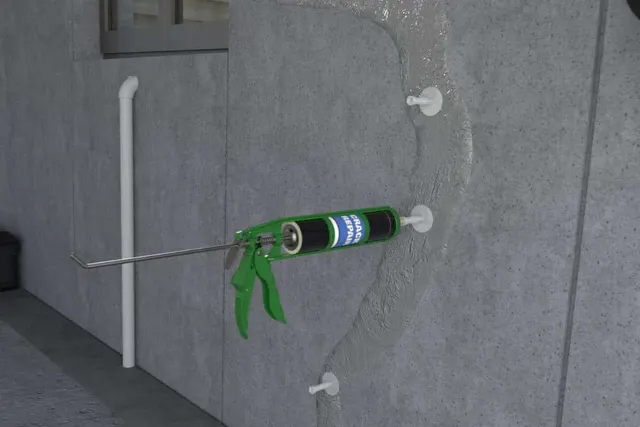
Epoxy injection works by completely filling the crack with a two-component structural epoxy that is injected under low pressure and allowed to penetrate the full depth and width of the crack before curing. The resulting bond is so strong that if the wall were ever stressed again, it would more likely crack adjacent to the injection than through it. Installation begins with port placement. Small injection ports are mounted at regular intervals along the crack, typically every 6 to 12 inches depending on the thickness of the wall and the width of the crack. The crack face is then sealed between ports with a surface paste to prevent epoxy from leaking out during injection. Injection proceeds from the lowest port upward. Epoxy is pumped into the lowest port until it begins to appear at the next port above, which confirms the void between those two ports has been filled. The lower port is then capped and the crew moves to the next port. This sequential process continues until epoxy emerges from the topmost port, confirming the entire crack has been filled. After cure time, the ports and surface paste are removed, leaving a structurally sound repair. A properly executed epoxy injection is invisible after surface preparation and painting. It is critical to distinguish epoxy injection (for dry, stable cracks) from polyurethane injection (for actively leaking cracks). Using epoxy in an actively leaking crack is ineffective because water contamination compromises the bond.
“A properly injected epoxy crack is actually stronger than the concrete on either side of it. The concrete might crack again, but it will not crack through the epoxy. That is the level of bond strength we are working with.”
How APS Installs Epoxy Crack Injection
- 1
Free On-Site Assessment
An APS inspector evaluates the crack to confirm it is dry, stable, and structurally significant. Cracks that are actively leaking or showing signs of ongoing movement are directed to polyurethane injection or additional structural repair.
- 2
Surface Cleaning
The crack face and surrounding concrete are cleaned of any loose material, dirt, or contaminants that could interfere with the port adhesive or the epoxy bond.
- 3
Port Installation
Injection ports are mounted along the crack at intervals appropriate to the wall thickness and crack width. Ports are bonded to the concrete surface with fast-setting adhesive.
- 4
Surface Seal Application
A surface paste is applied between the ports along the crack face, sealing the crack at the surface to contain the injected epoxy and direct it through the full depth of the wall.
- 5
Sequential Epoxy Injection
Two-component structural epoxy is injected into the lowest port under low pressure. Injection continues until epoxy appears at the next port upward, confirming complete fill between those two ports. The process repeats from bottom to top.
- 6
Cure and Port Removal
After the epoxy has cured, the ports and surface paste are removed and any surface irregularities are ground smooth. The crack has been returned to structural integrity.
What Epoxy Crack Injection Costs and What Is Covered
Cost Range
$300 to $1,200 per crack depending on length and wall thickness.
Warranty
APS in-house warranty on all epoxy injection work, transferable to new owners at no additional cost.
Frequently Asked Questions
How do I know if my crack should be repaired with epoxy or polyurethane?
The key distinction is moisture. Dry cracks that are structurally significant get epoxy injection because the bond strength is what matters. Cracks that are actively leaking or have a history of water infiltration get polyurethane foam injection because it expands, fills voids, and creates a flexible waterproof seal even in wet conditions. APS inspectors will make this determination during the free on-site assessment.
Will epoxy injection prevent the crack from leaking in the future?
A properly injected epoxy crack is solid material and will not leak through the repaired zone. However, epoxy is rigid. If the foundation experiences additional movement, a new crack may form adjacent to the repair rather than through it. For cracks where movement is ongoing, a structural solution such as piers or wall anchors may need to accompany or precede the crack repair.
Can epoxy injection be done from the inside?
Yes. Epoxy injection is performed entirely from the interior side of the wall. No exterior excavation or access is required, making it one of the least disruptive foundation repair methods available.
How long does epoxy take to cure?
Standard structural epoxies used in foundation injection reach full cure within 24 to 72 hours depending on temperature and humidity. The crack is sealed and the repair zone is complete immediately after injection; the full-strength bond develops over the cure period.