

What Stair-Step Cracks in Foundation or Brick Tells You About Your Foundation Repair
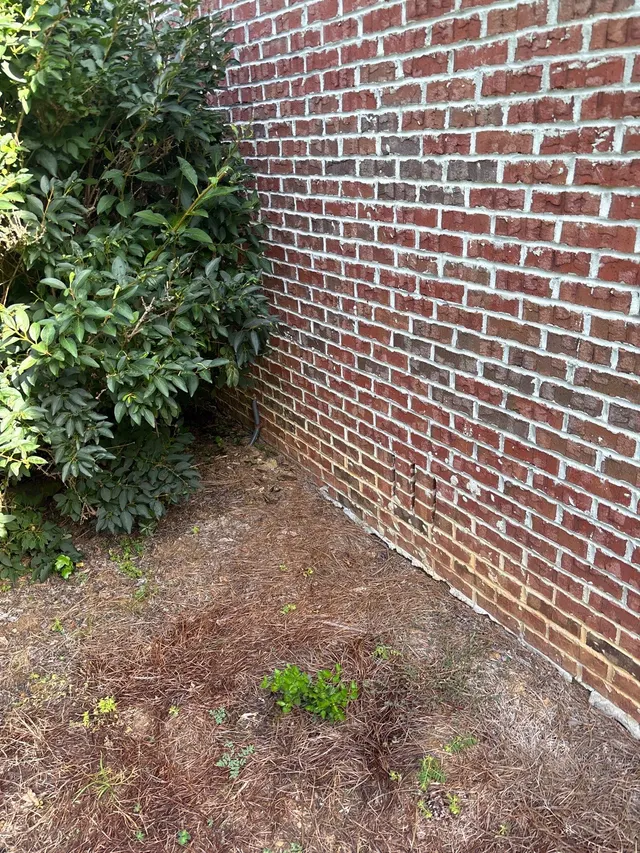
Stair-step cracks travel diagonally up or down through a masonry wall by following the mortar joints between bricks or blocks, stepping horizontally across one joint, then vertically up the next, in a repeating stair pattern. They are most visible in exterior brick veneer, concrete block foundation walls, and above basement windows. The crack often starts at a corner or opening and widens as it progresses upward.
Alabama's brick-veneer construction is ubiquitous in the Birmingham suburbs, Huntsville, and Mobile, making stair-step brick cracks one of the most common calls APS receives. Because many of these homes sit on expansive clay, stair-step cracking tends to worsen each wet season.
What Causes Stair-Step Cracks in Foundation or Brick in Alabama Homes
Differential Settlement
The most common cause: one part of the foundation is dropping while an adjacent section holds its position. The structure tries to accommodate the movement by cracking at its weakest points, the mortar joints, in the characteristic stair-step pattern.
Foundation Corner Failure
Corners of foundations are particularly vulnerable to settlement because surface water tends to concentrate there and soil is often less compacted at the perimeter. A dropping corner produces a classic stair-step crack radiating up and outward from that corner.
Lateral Foundation Movement
When soil pressure pushes one section of the foundation laterally, the masonry above shears along mortar joints in a diagonal pattern. This is common in block foundation walls subjected to hydrostatic pressure.
Expansive Soil Heave on One Side
If one part of the foundation sits on wetter or more active clay than the rest, for example, a side with poor drainage, that section may heave upward relative to others, also producing stair-step cracking.
Signs You Should Not Ignore
- Crack width greater than 1/4 inch or clearly widening over weeks
- Displacement across the crack, one side sitting higher or further out than the other
- Multiple stair-step cracks appearing at different locations on the same wall
- Cracks correlating with doors or windows that have recently started sticking
- Brick or block pieces spalling out at the crack location
How We Diagnose and Repair the Problem
- 1
Free On-Site Assessment
An APS technician visits your property, documents the symptom and severity, and reviews all related indicators to build a complete picture.
- 2
Root Cause Diagnosis
Push piers or helical piers stabilize the settling section of the foundation, stopping active movement; epoxy crack injection seals the crack after the structural cause is addressed.
- 3
Written Estimate
You receive a clear written scope of work and cost estimate before any repair begins. No obligation.
- 4
Repair With Transferable Warranty
All APS foundation repairs carry a warranty that transfers to future owners. Serving Birmingham, Mobile, Huntsville, and Columbus, GA.
“The direction and location of a stair-step crack tells us a lot about exactly which footing is moving and how much. It is one of the clearest diagnostic signs we see in the field.”
Frequently Asked Questions
Is every stair-step crack a sign of foundation failure?
Not necessarily. Hairline stair-step cracks less than 1/8 inch wide that have been stable for years can be caused by minor thermal movement or original construction settling. The concerns are cracks that are widening, show displacement across the joint, or are accompanied by sticking doors and sloping floors.
Can I just tuck-point the cracks and leave it at that?
Tuck-pointing fills the crack cosmetically but does nothing to address the underlying foundation movement. If the cause is active settlement, new cracks will appear near the repaired area within months or years. Address the structural cause first, then repair the masonry.
Why do stair-step cracks follow the mortar joints?
Mortar is inherently weaker in tension than the brick or block units themselves. When a wall is stressed by differential movement, it cracks at the path of least resistance, which is the mortar joint. The stair-step pattern is therefore an accurate map of which direction the foundation is moving.
How quickly do I need to act?
If the crack is stable and narrow, a professional inspection within a few weeks is appropriate. If the crack opened suddenly, is wider than 1/4 inch, shows displacement, or appeared after heavy rain, schedule an inspection as soon as possible. APS provides free on-site evaluations.