
What Is Carbon Fiber Wall Reinforcement?
Carbon fiber reinforcement is a high-strength, low-profile solution for bowing foundation walls that have experienced minor deflection and where movement has stabilized. High-tensile carbon fiber straps are bonded to the wall surface using structural epoxy, providing significant resistance to further inward movement without requiring any excavation, yard disruption, or exterior access. APS Foundation uses carbon fiber reinforcement as the right tool when deflection is less than 2 inches, movement has stopped, and the wall material is sound enough to support the bonded strap system.
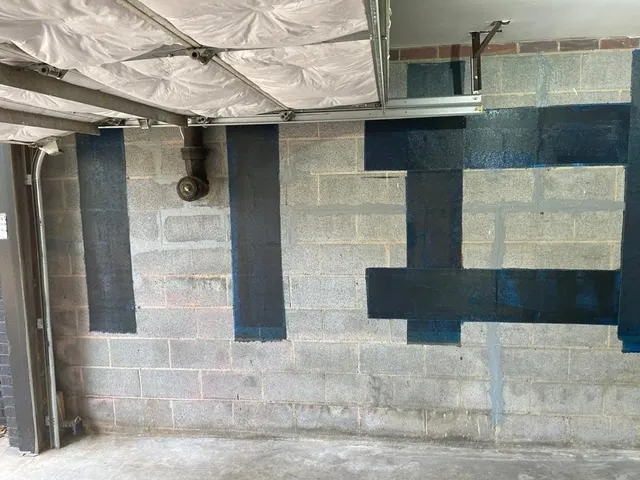
How Carbon Fiber Wall Reinforcement Works
Carbon fiber straps derive their strength from the same material used in aerospace and motorsport applications. The individual carbon fibers are bundled and woven into straps that, when fully bonded with structural epoxy, can withstand tens of thousands of pounds of tensile force. This tensile strength is put to work resisting the lateral soil pressure that causes foundation walls to bow inward. Installation begins with thorough surface preparation. The wall face is ground smooth and clean at each strap location to ensure a reliable epoxy bond. Any loose mortar, efflorescence, or contamination is removed. The structural epoxy is then applied to the wall, the carbon fiber strap is pressed firmly into the epoxy, and a second coat of epoxy saturates the strap and locks it to the wall surface. Once cured, the strap becomes integral with the wall and cannot be seen or felt behind a coat of paint. The bonded system resists the tensile forces created by soil pressure trying to push the wall inward, effectively acting as a tension reinforcement on the interior face of the wall. Carbon fiber reinforcement is not appropriate for actively moving walls. If a wall is still shifting, the shear forces between a moving wall and a fixed strap can break the epoxy bond or damage the wall material. APS inspectors will only recommend carbon fiber when monitoring or other evidence confirms movement has stopped. For walls still in motion or deflected beyond 2 inches, wall anchors or tiebacks are the appropriate choice.
“Carbon fiber is the cleanest solution when the wall qualifies. There is no excavation, no hardware on the yard side, and the finished wall looks almost untouched. The key is confirming movement has genuinely stopped before we commit to a bonded solution.”
How APS Installs Carbon Fiber Wall Reinforcement
- 1
Free On-Site Assessment
An APS inspector measures deflection, reviews crack patterns, and determines whether the wall's movement has stabilized. Carbon fiber is recommended only when deflection is under 2 inches and movement has stopped.
- 2
Wall Surface Preparation
The wall surface at each strap location is ground smooth and cleaned to bare, sound material. This preparation step is critical to achieving the full structural bond the system requires.
- 3
Epoxy Application
A structural epoxy primer is applied to the prepared wall surface at each strap location, creating the base layer of the bond.
- 4
Strap Installation
The carbon fiber strap is pressed firmly into the wet epoxy and worked flat to eliminate any voids or air pockets between the strap and the wall surface.
- 5
Saturating Coat and Cure
A second coat of structural epoxy is applied over the strap, fully saturating the carbon fiber weave and completing the bond. The system is allowed to cure fully before the wall is returned to service.
What Carbon Fiber Wall Reinforcement Costs and What Is Covered
Cost Range
$500 to $1,200 per strap; most walls require 2 to 4 straps.
Warranty
Manufacturer warranty plus APS in-house warranty, transferable to new owners at no additional cost.
Frequently Asked Questions
Will carbon fiber straps straighten my wall?
No. Carbon fiber reinforcement stabilizes the wall in its current position and prevents further inward movement. It does not apply corrective force to move the wall back toward plumb. If straightening is a goal, wall anchors with periodic retightening are the appropriate solution.
Can I paint over the carbon fiber straps?
Yes. Once the epoxy has fully cured, the straps can be painted or encapsulated with wall products. Many homeowners apply a skim coat of hydraulic cement over the straps before painting so the wall presents a uniform surface.
How do I know if my wall has stopped moving?
APS inspectors look for several indicators: crack edges that are equally weathered or stained on both sides, no fresh cracking adjacent to old cracks, and measurement data from multiple inspection visits. If movement is uncertain, we may recommend a monitoring period before installing carbon fiber reinforcement.
Is there any disruption to my yard?
None. Carbon fiber reinforcement is entirely an interior operation. No excavation, no exterior access, and no yard disturbance of any kind. This is one of the key advantages over wall anchor systems when the wall qualifies for carbon fiber.