

What Is Concrete Slab Lifting?
Concrete slab lifting using polyurethane foam injection is the most cost-effective and least disruptive way to raise settled sidewalks, driveways, pool decks, garage floors, and interior slabs back to their original elevation. APS Foundation drills small 5/8-inch holes through the settled concrete, injects high-density polyurethane foam that expands to fill voids and lift the slab, and the surface is walk-on ready within 30 minutes. APS does not use mudjacking. Polyurethane foam injection is lighter, faster-curing, and longer-lasting. For Huntsville homeowners, karst-related soil voids may require a site-specific assessment before determining whether foam lifting will provide a lasting result.
How Concrete Slab Lifting Works
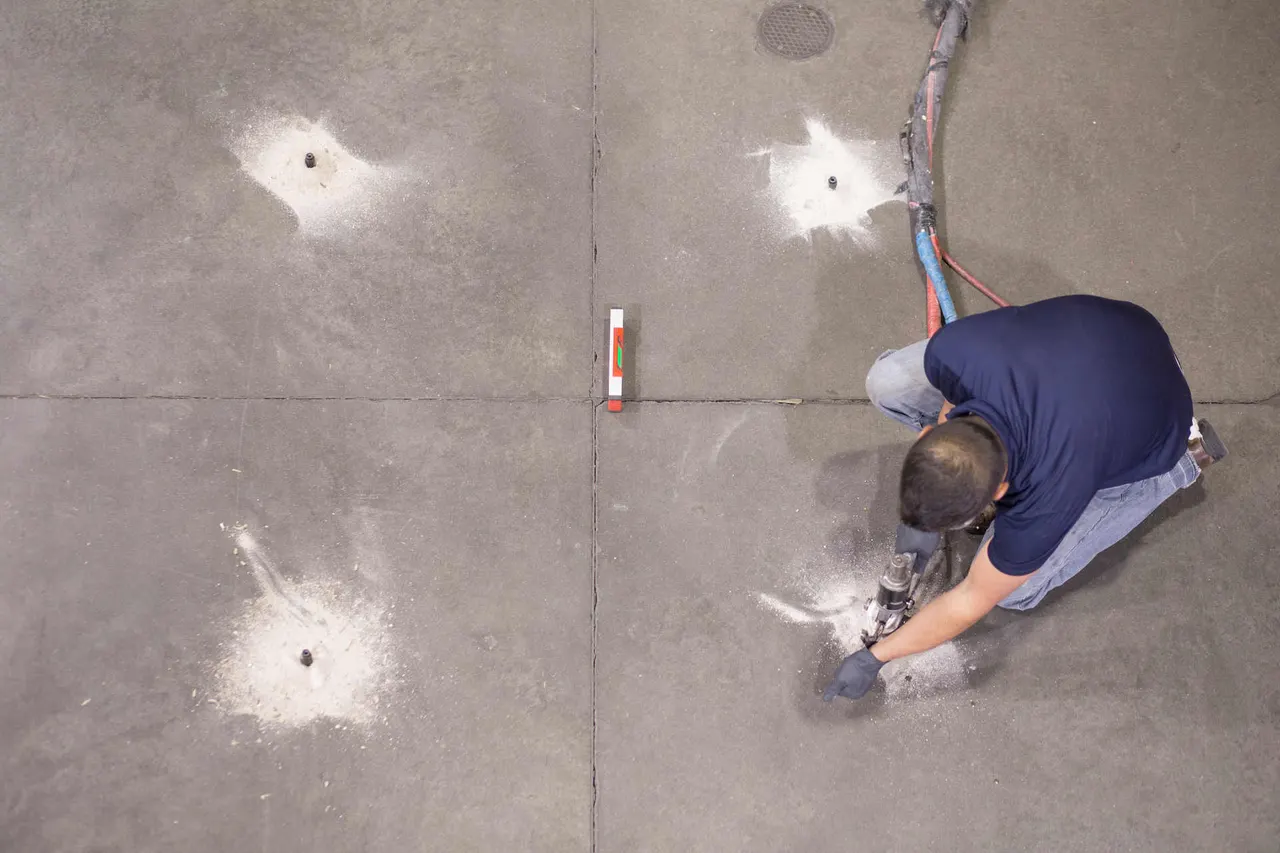
Concrete slab settlement happens when the soil beneath the slab loses volume or density through erosion, compaction, drying and shrinking, or the development of voids below the slab. Polyurethane foam slab lifting addresses this directly by filling the void and re-establishing support beneath the slab while simultaneously exerting upward force to lift the concrete to the correct grade. The process begins with calculating the injection locations. Our technicians map out where holes should be drilled to create the most uniform lift possible given the size, shape, and settlement pattern of the slab. Poorly placed injection points can cause a slab to lift unevenly or crack, so the layout is done with care before any drilling starts. Small 5/8-inch holes are drilled through the concrete at the planned locations. An injection port is inserted into each hole, and the polyurethane foam components are mixed at the tip of the injection gun and delivered into the void space beneath the slab. The foam expands rapidly, filling the void and pressing upward against the underside of the concrete. Elevation is monitored continuously at reference points across the slab during injection. Our crew adjusts the injection sequence in real time to keep the lift as uniform as possible. When the slab reaches the target grade, injection stops. The foam cures quickly and the surface is ready for pedestrian traffic within 30 minutes and vehicle traffic within a few hours. Injection holes are patched flush with the slab surface, leaving a nearly invisible repair. In Huntsville areas with known karst geology, large soil voids caused by limestone dissolution can exist beneath slabs. In these situations, APS will assess the void volume and soil conditions before committing to foam lifting as a permanent solution, since very large or active voids may recur.
“People are always surprised at how small the holes are and how quickly it is done. We drill, inject, watch it come up, patch the holes, and they are parking on it the same afternoon. Compare that to tearing out a driveway and waiting a week for new concrete to cure.”
How APS Installs Concrete Slab Lifting
- 1
Free On-Site Evaluation
An APS technician evaluates the settled slab, measures the elevation differential, and assesses the likely cause of settlement. Huntsville properties receive additional evaluation for karst-related voids.
- 2
Injection Point Layout
Injection holes are planned and marked on the slab surface to create a lift pattern that will raise the slab as uniformly as possible without causing stress fractures.
- 3
Hole Drilling
5/8-inch holes are drilled through the concrete at each planned injection point. These small holes are the only disruption to the slab surface and are nearly invisible once patched.
- 4
Foam Injection and Lift
High-density polyurethane foam is injected through ports in the drilled holes. The foam expands beneath the slab, filling voids and lifting the concrete. Elevation is monitored in real time.
- 5
Grade Verification
Once the target elevation is reached, injection stops. The technician verifies the grade across the full slab and makes final adjustments at individual ports if needed.
- 6
Hole Patching
Injection holes are filled with cement patching material and finished flush with the slab surface. The area is ready for pedestrian use within 30 minutes.
What Concrete Slab Lifting Costs and What Is Covered
Cost Range
$800 to $4,000 for most residential slabs, depending on slab size and void volume.
Frequently Asked Questions
How much does slab lifting cost compared to full replacement?
Polyurethane foam slab lifting typically costs 50 to 80 percent less than demolishing the existing slab and pouring a new one. There is also no downtime for curing and no disposal cost for the broken concrete. For most residential slab lifting projects, the cost savings are substantial while achieving the same functional result.
What slabs can APS lift?
APS lifts driveways, sidewalks, pool decks, garage floors, patios, interior concrete floors, and basement floor slabs. As long as the slab is structurally sound (not shattered or so badly cracked it would not hold together during a lift), polyurethane foam lifting is usually an option.
Will the holes show after patching?
The 5/8-inch injection holes are patched with a cement material that closely matches the surrounding concrete texture. On bare concrete, the patches are barely noticeable. On decorative or colored concrete, there will be some visible difference in patch color, which can be reduced with a concrete surface coating or stain applied after the repair.
My driveway has cracked, not just settled. Can it still be lifted?
Cracks in the slab do not necessarily prevent lifting, but the pattern and severity of the cracking affects how the slab will respond. APS technicians evaluate crack patterns before lifting to determine whether the slab will hold together during the process. In some cases, cracks can be addressed in conjunction with the lift.