
What Are Steel Push Piers?
Steel push piers are one of the most reliable methods for underpinning a settling foundation. APS Foundation has been installing push pier systems across Alabama since 1977, providing homeowners with a permanent, warrantied solution to foundation settlement caused by shifting or eroding soils. Each pier is hydraulically driven through the weak soil layer and locked onto bedrock or load-bearing strata, transferring the weight of the structure to a stable depth. In some cases, settled foundations can be partially or fully lifted back toward their original elevation.
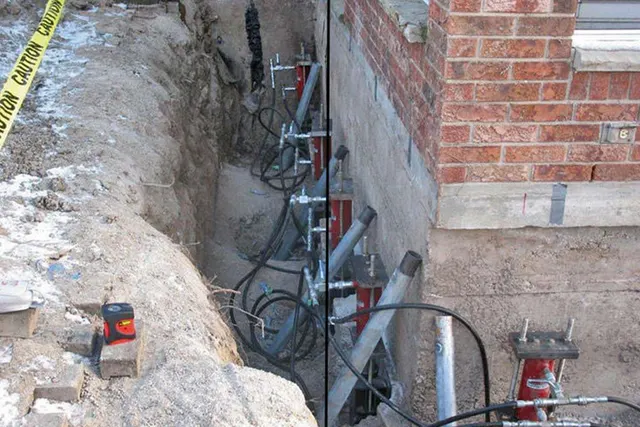
How Steel Push Piers Work
Push piers work by transferring a structure's load past unstable surface soil to competent bearing strata below. During installation, steel pier sections are hydraulically advanced through a bracket mounted to the existing footing. The driving continues until the pier reaches soil with the rated load capacity needed to support that section of the structure. Once all piers on a project are at target depth, our crew installs lift brackets and synchronizes hydraulic jacks across every pier simultaneously. This uniform lift minimizes stress on the structure and, when conditions allow, raises the foundation back toward its original position. For homes in Birmingham and the surrounding Red Mountain clay soil areas, push piers are particularly effective because the dense clay at depth provides reliable bearing capacity. Our crews are experienced with Alabama soil profiles and properly size each pier system for the actual loads present. Important note for Huntsville homeowners: the karst limestone geology common in the Tennessee Valley region can mean bedrock is fractured or at inconsistent depths. In these areas, a site assessment is required before recommending push piers versus helical piers, which use torque monitoring to confirm load capacity in real time regardless of bedrock depth.
“Push piers let us get past Alabama's problem soils and lock onto something that is not going anywhere. Once a pier is seated on load-bearing strata, that part of the foundation is not settling any further.”
How APS Installs Steel Push Piers
- 1
Free On-Site Assessment
An APS Foundation inspector evaluates the settlement, reviews soil conditions for your area, and determines whether push piers are the right solution. No two foundations are the same.
- 2
Excavation to Footing
Small excavations are made at each pier location to expose the footing. These excavations are typically 2 to 3 feet wide and are backfilled and restored after installation.
- 3
Bracket Installation
A galvanized steel bracket is bolted or welded to the foundation footing at each location. This bracket serves as the driving guide and load transfer point.
- 4
Hydraulic Pier Driving
Steel pier sections are driven hydraulically through the bracket, section by section, until the pier reaches load-bearing strata. The driving force and depth are recorded for each pier.
- 5
Synchronized Lift Attempt
Once all piers are at depth, hydraulic jacks are synchronized across every bracket. The structure is lifted uniformly; in many cases, a measurable recovery of elevation is achieved.
- 6
Lock-Off and Backfill
Piers are locked at the lift position, jacks removed, and excavations backfilled and compacted. The area is restored and the installation is documented in your warranty package.
What Steel Push Piers Cost and What Is Covered
Cost Range
$1,500 to $3,500 per pier installed; most residential jobs require 4 to 12 piers.
Warranty
Manufacturer warranty plus APS in-house performance warranty, both transferable to new owners at no additional cost.
Frequently Asked Questions
How many push piers does my foundation need?
Most residential projects require between 4 and 12 piers, depending on the size of the affected area, the weight of the structure, and how the load is distributed. Your APS inspector will calculate the pier spacing and quantity needed to meet the rated load capacity for your specific home.
Will my foundation be lifted back to level?
A full return to original elevation is not always possible, and attempting an aggressive lift can cause cosmetic damage inside the home. Our crew performs a controlled lift and stops when the structure responds optimally. Partial recovery is common and results in structural stabilization regardless of how much lift is achieved.
Are push piers the right choice for Huntsville?
Huntsville sits on karst limestone geology, which means bedrock can be fractured, cavernous, or at unpredictable depths. A site assessment is required before we recommend push piers in the Huntsville area. In many karst situations, helical piers are a better fit because torque monitoring during installation confirms real-time load capacity.
Is the warranty transferable if I sell my home?
Yes. Both the manufacturer warranty and APS's in-house performance warranty are transferable to subsequent owners, which can be a selling point when you list the property.