
What Expansive Soil Damage Tells You About Your Foundation Repair
Expansive soil is not a visible symptom on its own, it is the underlying condition that causes most of the foundation problems APS repairs across Alabama. Smectite clays, prevalent in the Birmingham metro, central Alabama, and parts of the Mobile region, can absorb water and expand up to 30% in volume when fully saturated. When they dry, they shrink by the same magnitude, pulling away from foundations and leaving voids beneath slabs and around footings. This cycle of expansion and contraction exerts alternating upward, lateral, and downward forces on foundations with every wet and dry season. Over years and decades, the cumulative effect causes settlement, heave, cracking, and structural distortion.
Alabama's smectite clay can expand up to 30% in volume when saturated, a swell potential that ranks among the highest for any soil type in the Southeast. The Birmingham metropolitan area sits largely on Appalachian Valley clay and weathered shale that is highly expansive. The Alabama Black Belt (named for its dark expansive clay soils) runs through central Alabama and into the Mobile region. Even in Huntsville, where karst limestone is a factor, clay overburden means expansive soil behavior must be considered in any foundation repair plan.
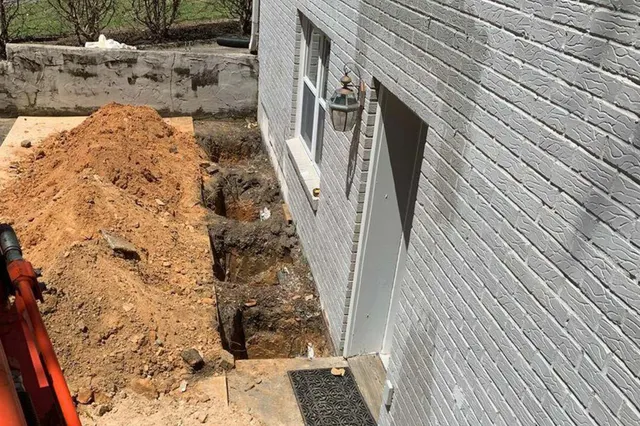
What Causes Expansive Soil Damage in Alabama Homes
Smectite Clay Mineral Content
Alabama's soils contain smectite clay minerals, including montmorillonite, that have an enormous capacity to absorb water between their molecular layers. When saturated, these minerals expand dramatically. When dried, they contract. The Birmingham area and central Alabama sit on some of the most smectite-rich soils in the Southeast.
Alternating Wet and Dry Seasons
Alabama's climate delivers wet winters and springs, punctuated by dry summer periods and periodic drought years. This alternating moisture availability drives the expand-shrink cycle that makes expansive soil so damaging. Each cycle stresses the foundation a little more, and the cumulative effect over 10 to 30 years can be severe.
Inadequate Soil Moisture Maintenance
Foundations perform best when soil moisture around them is kept as consistent as possible. Overwatering one side of a foundation, or letting the soil dry out dramatically on one side during drought, creates differential moisture conditions that cause uneven expansion and shrinkage, and differential movement in the foundation above.
Tree and Vegetation Root Activity
Large trees near the foundation aggressively extract moisture from nearby soil during dry periods, causing localized soil shrinkage and foundation settlement directly adjacent to the tree. This is one reason why one side of a foundation can settle while the other remains stable.
Signs You Should Not Ignore
- Foundation cracks that open in dry weather and partially close in wet weather, classic clay shrink-swell behavior
- Doors and windows that stick in wet seasons and loosen in dry seasons, cycling with rainfall patterns
- Visible soil pulling away from the foundation during dry summer months, leaving a gap at the perimeter
- Sloping floors that worsen after dry periods and partially improve after extended wet weather
- Driveways, walkways, or patios adjacent to the home that crack and move seasonally
- A large tree within 20 feet of the foundation with surface roots visible
- Stair-step cracks in brick veneer or block walls, especially on the side of the house with the most sun exposure
- Foundation problems that began or worsened after a drought year
How We Diagnose and Repair the Problem
- 1
Free On-Site Assessment
An APS technician visits your property, documents the symptom and severity, and reviews all related indicators to build a complete picture.
- 2
Root Cause Diagnosis
A Birmingham homeowner whose brick veneer had developed stair-step cracks over three successive drought-wet cycles contacted APS. Soil assessment confirmed high smectite clay content. The settled corner was stabilized with push piers driven to competent bearing below the active clay zone. Expansion joints were added to the brick to accommodate seasonal movement in the non-settled sections. Drainage improvements directed roof runoff away from the foundation to reduce moisture variability around the perimeter.
- 3
Written Estimate
You receive a clear written scope of work and cost estimate before any repair begins. No obligation.
- 4
Repair With Transferable Warranty
All APS foundation repairs carry a warranty that transfers to future owners. Serving Birmingham, Mobile, Huntsville, and Columbus, GA.
“People ask me what makes Alabama foundations so challenging. The answer is usually standing right under their feet, smectite clay that never stops moving. Our job is to anchor the foundation below where the clay can reach it.”
Frequently Asked Questions
Is all Alabama soil expansive?
Not uniformly, but smectite clay is widespread enough that expansive soil is a relevant concern across most of the state. The Birmingham area, the Alabama Black Belt, and portions of central Alabama have particularly high clay concentrations. Huntsville sits on a mix of clay and karst limestone. Mobile's coastal soils vary but include expansive clay zones. An APS site assessment includes soil evaluation relevant to your specific location.
Can I prevent expansive soil damage?
You cannot change your soil, but you can manage the moisture variability that drives the damage. Consistent soil moisture maintenance, through proper drainage, strategic irrigation during droughts, and keeping large trees appropriately distant from the foundation, reduces the amplitude of the expand-shrink cycle and slows cumulative damage. APS can advise on site-specific moisture management as part of a repair plan.
Do push piers work in expansive clay soil?
Yes, push piers and helical piers are designed to bypass the active clay zone and reach competent bearing soil or bedrock below. Once the foundation is anchored below the zone of clay movement, it is protected from future shrink-swell cycling in the surface clay layers. This is why deep underpinning is the standard repair for clay-related settlement in Alabama.
How do I know if my foundation problems are from clay or from another cause?
The seasonal pattern of your symptoms is a strong indicator, if problems worsen in dry weather and partially improve after rain, clay shrink-swell is likely a factor. An APS assessment combines visible symptom evaluation with soil assessment to confirm the diagnosis before recommending repairs.